
Have you ever picked up a graphic novel that genuinely changed your perspective on storytelling? For me, that experience came with Watchmen. This isn’t just a comic; it’s a profound journey into the human psyche, wrapped in a gritty, alternate history that still resonates decades later.
We’re about to revisit this monumental work, exploring why it continues to captivate new readers and seasoned fans alike. Get ready to dive into the intricate layers of a story that redefined what a superhero narrative could be, leaving an indelible mark on the medium.
Watchmen Graphic Novel Review: Why It Still Matters
When we talk about Watchmen, we aren’t just discussing a comic book. We are exploring a literary phenomenon.
I remember the first time I held this graphic novel in my hands. It felt heavy with importance.
Decades after its original release in 1986, Watchmen remains the gold standard for the industry.
We often ask ourselves why certain stories fade while others become immortal masterpieces.
Alan Moore and Dave Gibbons didn’t just write a story; they deconstructed a genre.
Before this work, superheroes were often seen as simple archetypes of pure good.
Watchmen changed that forever by asking the terrifying question: Who watches the watchmen?
It still matters today because it mirrors our own societal anxieties and political tensions.
The world within these pages feels gritty, real, and dangerously close to our own reality.
We see a reflection of our fears regarding authority, nuclear war, and morality.
Its cultural impact is so vast that it paved the way for prestige television and modern cinema.
Every time I revisit this book, I find a new layer of meaning I missed before.
It is a benchmark that every aspiring writer and artist must study to understand the craft.
The enduring relevance of Watchmen lies in its refusal to offer easy or happy answers.
It forces the reader to think, to question, and to confront the darkness within humanity.
For us at Hero and Villain World, this isn’t just a review; it’s a celebration of genius.
The Unforgettable Characters of Watchmen
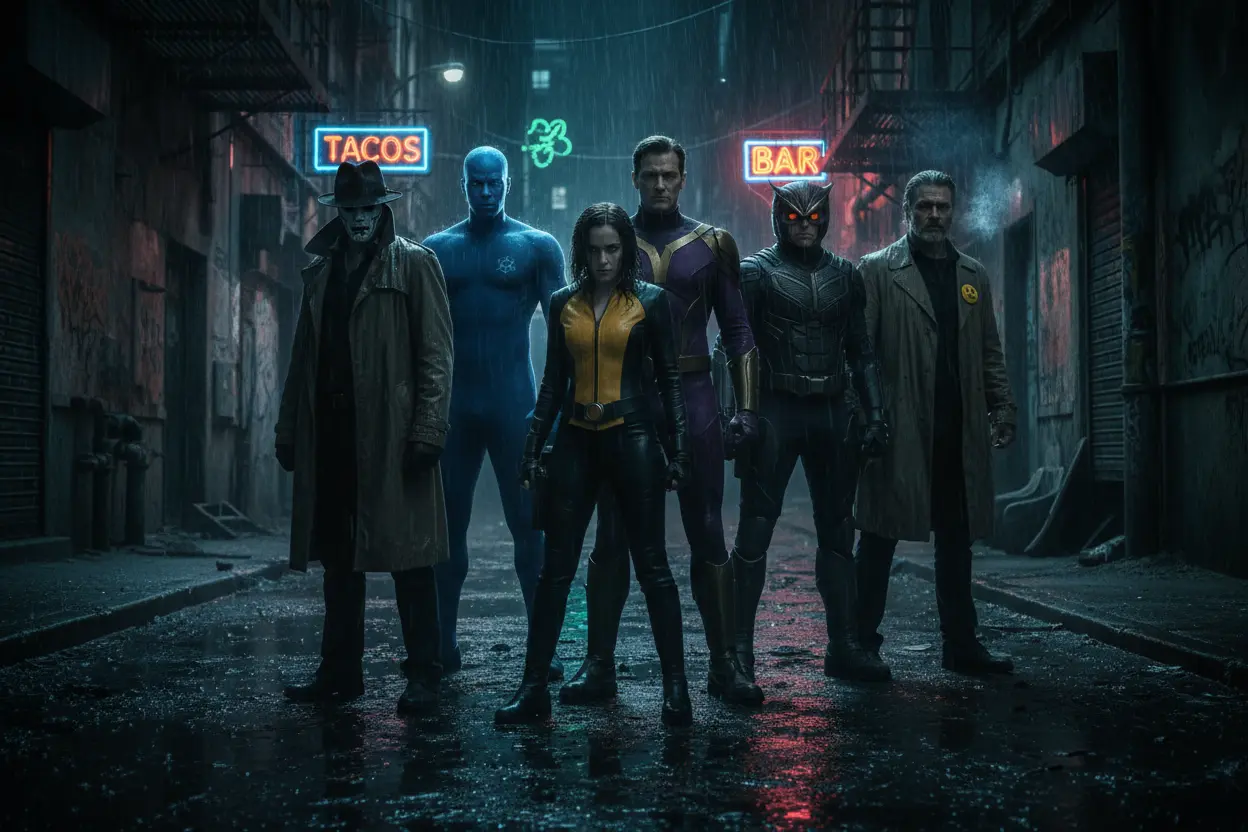
The brilliance of Watchmen lies in its deeply flawed and human characters.
They are not just heroes; they are psychological studies of what it means to be powerful.
Rorschach is perhaps the most iconic, with his shifting mask and uncompromising morality.
He sees the world in black and white, refuse to compromise even in the face of Armageddon.
Then we have Dr. Manhattan, a being who has transcended humanity to become a literal god.
His struggle to stay connected to human emotions is haunting and profoundly tragic.
Ozymandias, the “smartest man in the world,” redefines what it means to be a visionary leader.
His motivations are complex, making us wonder if his terrible actions were actually necessary.
Nite Owl II represents the mid-life crisis of the hero, full of nostalgia and insecurity.
He is the most relatable character, trying to find purpose in a world that moved on.
Silk Spectre II deals with the weight of legacy and the complications of her mother’s past.
Her journey is one of self-discovery amidst a world dominated by powerful, broken men.
Finally, The Comedian serves as the cynical heart of the entire narrative structure.
He saw the world as a cruel joke and decided to be the only one laughing.
| Character | Core Philosophy | Subversion of Archetype |
|---|---|---|
| Rorschach | Absolute Moral Absolutism | The “detective” who is mentally unstable and violent. |
| Dr. Manhattan | Determinism & Science | The “superman” who loses interest in saving humanity. |
| Ozymandias | Utilitarianism | The “hero” who commits a massacre for the “greater good.” |
| The Comedian | Nihilism | The “patriotic hero” who is actually a cynical predator. |
These characters subvert everything we thought we knew about superhero tropes.
They are messy, contradictory, and occasionally even repulsive, which makes them feel alive.

A New York Times best-seller!
In an alternate world where the mere presence of American superheroes changed history, the US won the Vietnam War, Nixon is still president, and the cold war is in full effect!
Watchmen begins as a murder-mystery, but soon unfolds into a planet-altering conspiracy. As the resolution comes to a head, the unlikely group of reunited heroes–Rorschach, Nite Owl, Silk Spectre, Dr. Manhattan and Ozymandias–have to test the limits of their convictions and ask themselves where the true line is between good and evil.
Alan Moore’s Masterful Storytelling
Alan Moore is a wizard of words, and Watchmen is his most potent spell.
The narrative techniques used here were revolutionary for the comic book medium in the eighties.
We are treated to a non-linear structure that jumps through time with surgical precision.
This creates a sense of inevitability and dread that permeates every single chapter.
Moore utilizes subplots like the Tales of the Black Freighter to mirror the main story.
This “story within a story” adds a metaphorical depth that is rarely seen in graphic novels.
The use of back-matter, such as fictional news clippings and book excerpts, is brilliant.
These documents build a dense, layered universe that feels completely lived-in and authentic.
The dialogues are profound, often reading like high-level philosophy or classic literature.
Nothing in this book is accidental; every word serves a specific, calculated purpose.
We find ourselves rewarded by multiple readings, discovering hidden connections every single time.
It is a masterclass in how to build tension and develop characters through subtle interactions.
Moore doesn’t hold the reader’s hand; he expects us to engage deeply with the material.
The complexity of the plot is balanced by the emotional weight of the character arcs.
It is a symphony of narrative threads that come together in a shocking, unforgettable finale.
We are constantly amazed at how Moore manages to weave politics, science, and myth together.
This is storytelling at its most ambitious and successful level imaginable.
Dave Gibbons’ Iconic Art Style
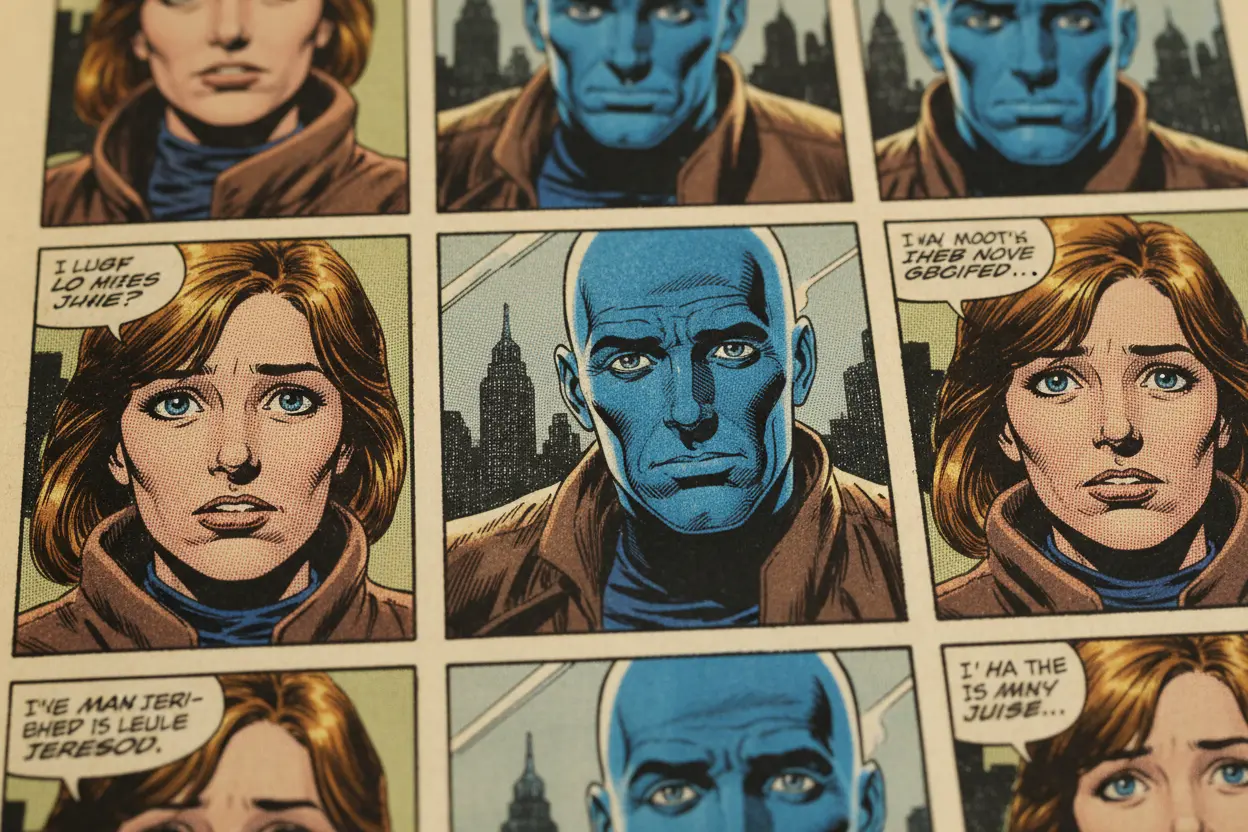
While Moore provided the soul, Dave Gibbons provided the unmistakable body of Watchmen.
His art is meticulous, filled with details that demand your full attention.
The most famous aspect of his work here is the nine-panel grid layout.
This rigid structure creates a cinematic rhythm that controls the pace of the reading experience.
It allows for parallel storytelling, where two different scenes unfold simultaneously across the page.
Gibbons’ ability to convey facial expressions adds a layer of humanity to the characters.
We can see the weariness in Nite Owl’s eyes and the cold detachment of Dr. Manhattan.
John Higgins’ color palette is equally essential to the book’s unique visual identity.
He moved away from the primary colors of traditional comics, using secondary hues instead.
The purples, oranges, and pinks give the world a moody, neon-noir atmosphere.
This aesthetic choice perfectly complements the cynical and mature tone of the story.
The visual motifs, like the blood-splattered smiley face, have become global icons.
There is a symmetry in the art that often mirrors the themes of the writing.
Chapter five, “Fearful Symmetry,” is a technical marvel where the pages mirror each other visually.
This level of artistic coordination between writer and artist is extremely rare and precious.
The art doesn’t just illustrate the words; it elevates them into a unique visual experience.



Themes That Resonate Deeply
Watchmen is a treasure trove of philosophical and social themes that remain relevant.
At its core, it explores the nature of power and how it inevitably corrupts those who hold it.
The concept of morality is stripped bare and examined under a harsh, unforgiving light.
We are forced to ask if the end justifies the means in a world on the brink of destruction.
The theme of surveillance is also prominent, echoing modern concerns about privacy and control.
“Who watches the watchmen?” is a question about accountability in a democratic society.
We see the end of idealism, as the “Golden Age” heroes are replaced by cynical mercenaries.
The book is a biting social critique of the Reagan-era politics and Cold War paranoia.
Existentialism is explored through Dr. Manhattan, who perceives time as a simultaneous whole.
His perspective challenges our understanding of free will versus predestination.
The nature of humanity is questioned: are we worth saving, or are we naturally self-destructive?
These themes are not just window dressing; they are the beating heart of the narrative.
They provoke deep thought and discussion long after the final page is turned.
We find these discussions just as urgent today as they were in the mid-eighties.
The graphic novel serves as a warning about the dangers of unchecked authority and ego.
It is a work that respects the reader’s intelligence by presenting complex, unsolvable dilemmas.

HUGO AWARD WINNER | A NEW YORK TIMES BESTSELLER
In an alternate America, a murder mystery evolves into an ominous, planet-wide conspiracy in a world where superheroes shifted the course of history as we know it
The paperback edition of the groundbreaking masterpiece from comics legends Alan Moore & Dave Gibbons that took apart the infallible superhero archetype, forever changing graphic storytelling
Is Watchmen Worth Your Time?
If you haven’t read Watchmen yet, you are missing out on a pivotal piece of art.
It is widely considered one of the greatest works of fiction of the 20th century.
Whether you are a lifelong comic fan or a literary enthusiast, this book is essential.
The value of reading it lies in its ability to expand your perspective on storytelling.
It is a timeless masterpiece that has influenced countless movies, shows, and other books.
We believe that every reading offers a richer experience than the one before it.
The legacy of Watchmen is secure as the definitive deconstruction of the superhero myth.
It is a challenging read, but the rewards are well worth the intellectual effort required.
You will come away with a new appreciation for what the graphic novel medium can achieve.
Don’t just take our word for it; experience this journey for yourself and see the world differently.
The characters will haunt you, the themes will provoke you, and the art will mesmerize you.
It is a rare gem that lives up to every bit of the massive hype surrounding it.
We are grateful that such a work exists to push the boundaries of our favorite hobby.
Grab your copy, find a quiet spot, and prepare to be completely immersed in this world.
Watchmen isn’t just a book you read; it’s a masterpiece you experience with your whole soul.
It is, without a shadow of a doubt, absolutely worth your time.
The Enduring Legacy of Watchmen
Revisiting Watchmen is always a gratifying experience and, for me, a reminder of the power that comic books possess. It’s a work that challenges us, makes us question, and above all, entertains us with a rare depth. I am eternally grateful for having had the opportunity to delve into this universe.
And you, what’s your favorite part of Watchmen? Share your thoughts in the comments below and let’s continue this conversation about one of the greatest graphic novels of all time! Your opinion is very important to us.
FAQ – Common Questions About Watchmen
We know that diving into such a legendary work can spark many questions. Here are some quick answers to help you navigate your watchmen graphic novel review journey!
While it is quite dense, we believe it’s a perfect entry point if you want to see the true literary potential of the medium. This watchmen graphic novel review highlights how it subverts traditional tropes, making it a fascinating, though complex, first read for any enthusiast.
It revolutionized the industry by introducing deconstructed heroes and mature themes that remain incredibly relevant today. The combination of Alan Moore’s narrative and Dave Gibbons’ meticulous art creates a layered storytelling experience that we find unmatched in the genre.
Honestly, we recommend it for mature audiences due to its graphic violence, complex political themes, and adult content. It is a serious work of fiction that explores the darker side of human nature and the nature of power in a very realistic way.
Not at all! One of the reasons we love it is that it exists in its own self-contained universe. You can dive right into the book without any prior knowledge of other superheroes, as it creates its own unique internal mythology.
Absolutely! While the adaptations are interesting, they cannot fully capture the intricate nine-panel grid and the deep subplots found in the original pages. We always say that the source material offers a much richer and more nuanced experience than any screen version.