Disclaimer: This post contains affiliate links. If you make a purchase through these links, I may earn a small commission at no extra cost to you.
Introduction to a Timeless Legend
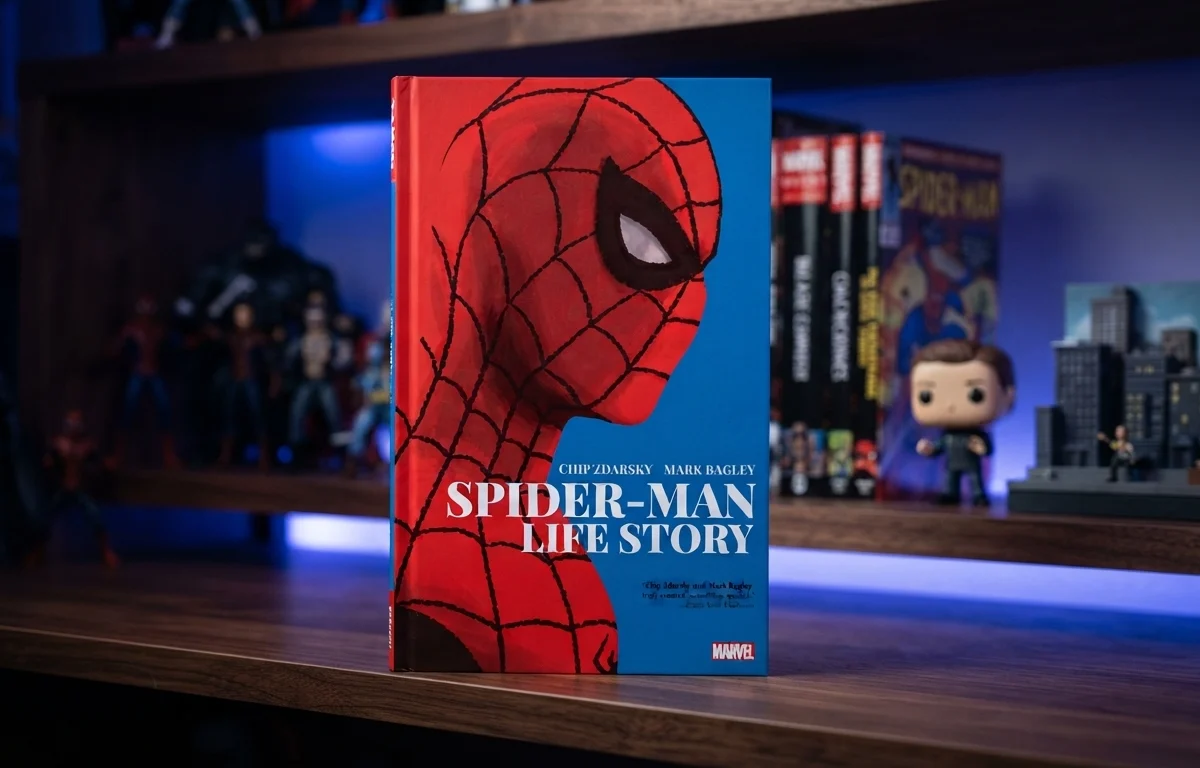
Here at Hero and Villain World, within our product reviews category, I aim to analyze the most impactful comic books, graphic novels, and geek collectibles on the market. Few characters in popular culture carry the emotional weight of Peter Parker.
Yet, mainstream comic book continuity has a glaring flaw: characters never truly grow old. We see Peter Parker perpetually stuck in his late twenties, fighting the same battles across endless reboots.
That is why I was incredibly excited to dive into Spider-Man: Life Story. This graphic novel asks a simple, fascinating question: what if Peter Parker aged in real-time from his debut in 1962 to the modern era?
Written by Chip Zdarsky and illustrated by the legendary Mark Bagley, this paperback collects a six-issue miniseries that chronicles six decades of history. In this honest review, I will break down whether this ambitious narrative experiment is actually worth your hard-earned money.
Spider-Man: Life Story (Paperback)
Brand: Marvel Comics
Estimated Price: $24.99 USD (MSRP) / Retails around $15.00 – $21.00 USD
Bonus Offers: Includes Free Shipping and a 30-Day Money-Back Guarantee when purchased through our retail partner.
A breathtaking graphic novel exploring Peter Parker’s complete life story as he ages in real-time from 1962 to 2019.
The Bottom Line / Verdict
Editor’s Choice
Rating: 4.8 out of 5 stars
I believe this is one of the greatest Spider-Man stories ever written. It manages to ground the wild fantasy of the Marvel Universe in real human struggle, making every loss feel permanent and every victory earned.
The creative synergy between Chip Zdarsky and Mark Bagley is outstanding. They have crafted a narrative that serves as both a love letter to Spider-Man history and a profound meditation on the passage of time.
If you love Spider-Man, this is an absolute must-have for your physical bookshelf. Check the current price at the link to secure your copy.
How We Tested
To provide a truly honest review, I analyzed this trade paperback across several key performance parameters. I read the entire volume multiple times, focusing on narrative cohesion, historical integration, and character development.
I also carefully examined the physical build quality of the paperback edition. I tested the spine durability by opening it flat, checked the color registration of the printing, and evaluated how well the paper resists fingerprints.
Finally, I compared this narrative to other classic self-contained Spider-Man graphic novels to see if it holds up as a standalone masterpiece.
Specs / Key Features
| Specification | Details |
|---|---|
| Format | Trade Paperback (Also available in Hardcover and Kindle/Digital editions) |
| ISBN-13 | 978-1302917333 |
| Page Count | 208 pages |
| Publisher | Marvel Universe (October 22, 2019) |
| Creative Team | Chip Zdarsky (Writer), Mark Bagley (Artist) |
| Dimensions | 10.0 x 6.4 x 0.4 inches |
| Weight | 0.8 pounds |
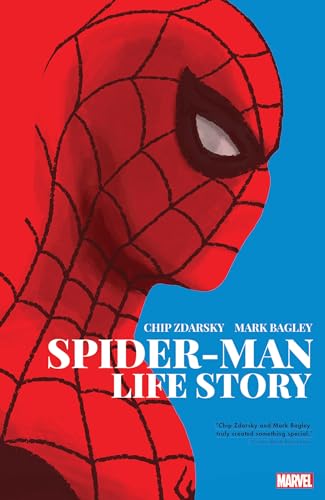
Collects Spider-Man: Life Story #1-6. Spider-Man makes history! In 1962’s AMAZING FANTASY #15, 15-year-old Peter Parker was bitten by a radioactive spider and became the Amazing Spider-Man! Fifty-seven years have passed in the real world since that event – so what would have happened if the same amount of time passed for Peter? To celebrate Marvel’s 80th anniversary, Chip Zdarsky and Spider-Man legend Mark Bagley unite to spin a unique Spidey tale – telling an entire history of Spider-Man from beginning to end, set against the key events of the decades through which he lived! From the Vietnam War to Secret Wars and Civil War, all the way through to what just might be a 72-year-old Spider-Man’s final mission, prepare to watch Peter Parker age through 57 years of groundbreaking history – and find out what happens to him and those he loves the most!
Report an issue with this product or seller
Note on variations: The Trade Paperback version reviewed here offers excellent value, while the Deluxe Hardcover contains extra pages, and the Kindle/Digital version is perfect for mobile reading.
The decade-by-decade narrative format is the core feature of this book. Each chapter covers a specific ten-year period, allowing us to see Peter Parker grow from a teenager in the 1960s to an elderly man in the 2010s.
The historical integration is seamless. Real-world events like the Vietnam War and the Cold War directly affect the lives of Peter and his friends, adding a layer of realism rarely seen in comics.


Deep Dive: Six Decades of Spider-Man
Let’s break down how this story handles the passage of time. Each chapter represents a single decade, starting with the 1960s.
The 1960s and 1970s: The Price of Responsibility
In the 1960s chapter, Peter is a college student grappling with the Vietnam War. While Flash Thompson enlists to fight, Peter struggles with his conscience, wondering if Spider-Man should intervene in a human conflict.
The 1970s chapter introduces the tragic fate of Gwen Stacy, but with a twist. The clone saga begins early, driven by the obsessive Jackal, forcing Peter to make choices that will alter his relationships forever.
I loved how these early chapters capture the classic Stan Lee and Steve Ditko era while introducing mature themes. The emotional stakes are raised because we know these characters cannot simply reboot next month.
The 1980s and 1990s: Dark Days and Clone Confusion
During the 1980s, Peter is married to Mary Jane, but the physical toll of his superhero life is starting to show. This era beautifully integrates the classic alien costume saga and Kraven’s Last Hunt.
For a deeper look at that legendary storyline, you can check out my Spider Man Kraven Last Hunt Review Should You Buy It.
The 1990s chapter takes on the infamous Clone Saga. Instead of the endless confusion of the original run, Zdarsky reframes it as a tragic family drama, giving Ben Reilly a beautiful, heartbreaking role.
I found this to be one of the strongest chapters. It takes a historically disliked comic era and turns it into a masterclass in emotional storytelling.
The 2000s and 2010s: Legacy and the Final Web
In the 2000s, Peter is an aging businessman dealing with the fallout of the Superhero Civil War and the threat of Morlun. His relationship with Tony Stark highlights the clash between corporate heroics and street-level responsibility.
Finally, the 2010s chapter brings Peter’s story to a close. Now an elderly man, he must pass the mantle to Miles Morales while facing his final, ultimate challenge.
The ending of this book is incredibly moving. It ties together all of Peter’s struggles over fifty years into a single, beautiful message about what it means to be a hero.
The Competition: Top Alternatives
How does this book stack up against other legendary Spider-Man stories?
If you are looking for another deeply emotional, retrospective look at Peter’s early years, I highly recommend reading Jeph Loeb & Tim Sale: Spider-Man Blue – An Honest Review. That book focuses on grief and Peter’s love for Gwen Stacy, offering a more intimate, melancholy tone.
While Spider-Man: Life Story covers six decades of history, Spider-Man: Blue focuses on a single, pivotal period. Both are masterpieces, but Life Story is much broader in scope.
Another great point of comparison is the original Kraven’s Last Hunt. While that story is a dark, psychological thriller, Life Story uses those same events to show how Peter’s aging affects his ability to survive such brutal encounters.
Pros & Cons
- Brilliant Storytelling Premise: The real-time aging mechanic provides an incredibly emotional, complete, and satisfying narrative arc that comic readers rarely get to experience.
- Spectacular Artwork: Mark Bagley’s illustration style is a perfect fit, showing a masterclass in how to dynamically and realistically age characters without losing their iconic designs.
- Dramatic Gravity: Incorporating real-world historical conflicts and consequences adds heavy ethical weight, heightening the emotional stakes of Peter’s classic moral code.
- Assumes Prior Lore Knowledge: Readers who have absolutely no background in classic Spider-Man continuity might miss the emotional depth of certain twists or alternate-universe references.
- Fast Narrative Pace: Condensing several decades of complex story arcs into six issues means some events, secondary character fates, and transitions are resolved quite abruptly or happen off-panel.
Real Reviews Section
Here is what real buyers have to say about this graphic novel:
Michael A. Lake ★★★★★ Verified Purchase
“A newcomer will enjoy it, but miss a chunk of nuance in the story. A long-time fan will find a concerto of the life and times of Peter Parker. Whatever you are expecting, this story both is and isn’t it. And I mean that in the best possible way.”
Cristian Romero ★★★★★ Verified Purchase
“Deeper and down to earth iteration of Peter story. It is not a graphic novel for kids or just to have fun. It addresses complex topics and issues universal to us, having time and it’s impact on our lifes as a core theme.”
Alan F. Bessen ★★★★★ Verified Purchase
“What a terrific take on Spider-Man. I love when a creator just still captures the essence of the character and just runs with it. Extremely enjoyable, that I devoured in one sitting.”
Taylor J. Huston ★★★★☆ Verified Purchase
“I have to admit, I was not expecting this comic to be as good as it was. Probably one of the best Spider-Man comics in the last ten to twenty years. I give Spider-Man: Life Story a 4/5 and a ‘Worth adding to your collection’ approval rating!”
“Spider-Man: Life Story is a profound meditation on time, responsibility, and what it truly costs to be a hero when the world refuses to stop spinning.”
Frequently Asked Questions
Is Spider-Man: Life Story suitable for complete beginners?
While a newcomer can certainly enjoy the basic plot, having some prior knowledge of classic Spider-Man lore makes the reading experience much richer. Knowing the major events of the 1970s clone saga and the 1980s symbiote saga adds incredible emotional depth to the story.
How easy is it to follow the fast-paced time jumps?
The transition between decades is handled very smoothly. Each chapter represents a single decade, and the visual design of the characters and technology changes progressively to help you follow the passage of time.
How well does the paperback edition hold up over time?
The trade paperback is made of high-quality printed paper with a durable perfect-bound spine. To keep it in pristine condition, store it vertically on a sturdy bookshelf in a cool, dry environment away from direct sunlight.
What are the main drawbacks of this story?
Because the book condenses sixty years of history into just six chapters, the narrative pace can feel very fast. Some secondary character fates and transitions are resolved abruptly or happen entirely off-panel.
Is it better to buy the physical paperback or the digital Kindle version?
While the digital Kindle version is available for a lower price, I highly recommend the physical trade paperback. Mark Bagley’s gorgeous, detailed artwork looks spectacular on high-quality printed paper, making it a great addition to any physical collection.