
Captain Marvel’s Unstoppable New Power Explained

Captain Marvel’s Unstoppable New Power connects straight back to her origin and shows why this upgrade matters. You’ll see what the comics say about the Kree link and how the MCU version flips details.
You get a simple take on energy absorption, flight, strength, and durability. You’ll learn how Binary and other upgrades shaped this Carol Danvers power upgrade, spot the limits and counters, and see how this power shifts fights, teams, and story stakes.
Key Takeaway
- She breaks limits with raw energy
- Her blasts strike harder and reach farther
- Her power forms a strong shield around her allies
- Enemies pause and rethink when they face her
- It gives new ways to protect people and shape outcomes

How you can trace Captain Marvel’s Unstoppable New Power to her origin
You can follow Carol Danvers’ trail like a bright streak through history. In the comics, her strength starts with Kree contact and alien tech that rewired her body. Over time, writers gave her upgrades — new batteries added to the same engine — that pushed her from a tough pilot to a cosmic force.
That shift explains why Captain Marvel’s Unstoppable New Power feels both familiar and brand new: it grew out of older threads, not from nowhere.
Look at the main threads that feed her power:
- Kree military tech and exposure
- Genetic changes
- Later cosmic energy infusion from alien devices or experiments (see how fictional devices reshape heroes in Marvel tech breakdowns)
Note: comics give you a layered origin, the MCU ties her to the Tesseract, and both versions explain her huge energy output — just in different languages.
What comics tell you about her origin and the Kree connection
Comics tell a layered story. Early Carol was an Air Force officer who crossed paths with Kree forces and tech. That contact left a lasting mark: parts of her abilities are presented as the result of alien tech or altered genes linked to Kree science.
For a concise published overview, see Carol Danvers comic origins and evolution. Writers later amplified her by giving her cosmic-level upgrades, so what starts as military-grade enhancement becomes star-level power.
Those comic origins also teach you that her strength is flexible on the page. One storyline might show her surviving direct hits and punching mountains; another gives her control over stellar energy as Binary. The takeaway: the comics built her power in steps, so when she pulls off something massive, it feels earned.
How the MCU origin differs and why Captain Marvel MCU power explained matters
In the MCU, Carol’s abilities come from an engine powered by the Tesseract — the Space Stone — rather than Kree genetic tampering. That explosion filled her with raw cosmic energy. The film simplifies things: one bright event, one source.
For viewers, that makes her power immediate and dramatic — a single origin beat to latch onto instead of decades of comic retcons (context for the Space Stone era appears in the site’s overview of The Infinity Saga). For the official on-screen profile, see Official MCU profile and origin details.
Simplified MCU sequence:
- Mar-Vell (as Dr. Lawson) builds a Tesseract-powered engine.
- A test goes wrong and the engine explodes.
- Carol absorbs the engine’s energy and gains her abilities.
Why this matters: the MCU origin shapes how you expect her to act. If her power comes from the Tesseract, she’s tied to cosmic-level threats and to how the MCU treats Infinity Stones. That affects where she fits in battles, alliances, and her emotional arc.
What the origins teach you about her core abilities
Both comic and MCU routes point to the same core skills: flight, superhuman durability, energy absorption, and energy projection like photon blasts. For quick science context on how those abilities read visually and physically, see the site’s explainers on superhero flight and super strength.
Comics may add cosmic control layers while the MCU emphasizes raw energy from the Space Stone. In practice, Carol can tank hits, fly through space, and redirect or unleash massive energy — whether you think of her as Kree-affected, a modified human, or a being charged by cosmic force.
| Aspect | Comics (typical) | MCU |
|---|---|---|
| Source | Kree contact later cosmic upgrades | Tesseract (Space Stone) engine explosion |
| Level | Military → Cosmic (retcons add power) | Instant cosmic-level power |
| Mechanism | Genetic/tech alteration, experiments | Energy infusion from Space Stone |
How you learn how Captain Marvel’s Unstoppable New Power works in simple terms
Watch what she does and ask: how does the energy appear and move? Pay attention to the glow, the sound, and how the air reacts. These signs tell you if she’s charging, holding, or letting go. Think of it like watching lightning build in a storm — you see the step before the strike.
Break the power into three pieces: absorption, projection, and physical boost. Watch one scene for absorption, another for firing, and a third for lifting or taking hits. This method helps you understand Captain Marvel’s Unstoppable New Power without getting lost in comic-book jargon.
Finally, compare what you see to everyday experiences. Energy absorption is like plugging into a battery. Projection is like flipping the switch. The physical boost is like sprinting after a strong caffeine hit.
For basic context on real energy transfer, check Basics of energy and energy transfer. Keep notes or screenshots. Over time you’ll recognize patterns and predict how she’ll react in a fight.
How Captain Marvel energy absorption lets you see her charge and fire energy
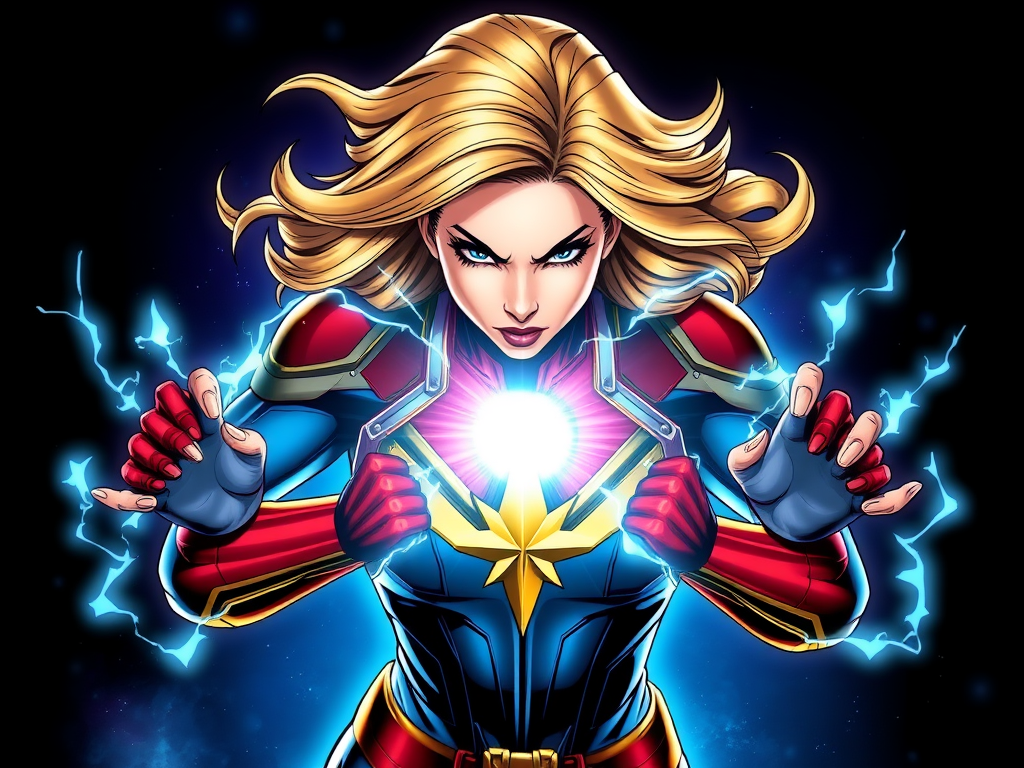
Energy absorption shows up as a rising glow around her core and hands. The color and intensity change as she pulls energy in. Small electrical arcs or a shimmer often move inward, like light being funneled into a single point — a visual that tells you she’s gathering power.
Quick cues to know when she’ll fire:
- Glow intensifies and centers
- Hair and clothes ripple from the energy pressure
- Nearby light bends or sparks appear
Callout: if the glow pulses fast, expect a single huge blast. If it holds steady, she might use several smaller shots or stay powered up.
She charges like a sunrise building to a supernova — slow warmth, then sudden, blinding power.
How flight, strength, and durability combine — a power breakdown for fans
Flight lets her use energy anywhere. While airborne, her energy projection gets a wider arc and more range. In close combat, flight gives momentum so punches land harder.
Strength and durability are the safety net; the same energy that fuels her blasts also reinforces her body. When she takes hits, you’ll notice less damage than expected. That endurance lets her push through heavy fights and keep firing. Together, these traits make her a versatile fighter on both offense and defense.
| Power Component | What it does | What you’ll notice |
|---|---|---|
| Energy Absorption | Stores external power | Bright inward glow, arcs, pressure |
| Energy Projection | Fires blasts or beams | Bursts of light, shockwaves, scorched impact |
| Flight | Mobility and range | Smooth sudden shifts, aerial maneuvers |
| Strength & Durability | Physical force and resilience | Powerful strikes, little visible injury |
A short, clear power breakdown you can remember
Think: Charge → Control → Release. She soaks up energy, channels it into her body, then lets it out as blasts or bolstered strength. That three-step loop is the core of her ability — and the essence of Captain Marvel’s Unstoppable New Power.
Why you should view this as a Carol Danvers power upgrade in her history
See this as an upgrade because it builds on what Carol already could do and pushes her into a new lane. Her powers are like a muscle — some moments bulked her up, others rewired her. This change isn’t a random spike; it stacks on top of past abilities and gives you a different sense of what she can handle now.
Early Captain Marvel stories showed a strong pilot with enhanced strength and flight. Later events like Binary and cosmic encounters layered energy control and scale on top of that. The current state is the next step: bigger reach, sharper control, and a new role on the cosmic stage.
How Binary and other upgrades changed Carol Danvers over time
Binary connected Carol to a stellar energy source and was a major turning point. It gave new visuals — full-body energy, starfire levels — and shifted threats she could face.
Other upgrades (tech boosts, Kree enhancements, energy mergers) added tools: energy absorption, focused photon blasts, and higher endurance. Each change shifted expectations for her role in fights and leadership.
| Upgrade Phase | Source | Key Effects | Notable Outcome |
|---|---|---|---|
| Early (Ms. Marvel) | Military/mechanical | Strength, flight, durability | Street-level heroism |
| Binary | Cosmic link | Stellar energy, massive output | Cosmic-level fights |
| Kree/Tech boosts | Alien tech & experiments | Energy control, resilience | Strategic power use |
| Recent evolution | Internal mastery cosmic hints | Enhanced control, broader role | Captain Marvel’s Unstoppable New Power |
Note: this evolution reads like a character arc where power equals responsibility — and the comics show that tension clearly.
What comic milestones help you track her power growth
Trace her growth by landmark issues and events where her power visibly changes. Look for origin shifts, major battles, and crossovers where writers change her scale or role. These moments are signposts that tell you how authors want you to think about her capabilities.
Core milestones:
- Ms. Marvel origin issues — baseline human-level powerhouse
- Binary transformation — leap to cosmic energy
- Kree-related arcs and experiments — tests and refinements
- Major crossover events — leader or heavy hitter roles
- Recent solo runs — focus on control and purpose
These stops show a pattern: more scope, more control, and a steady rise in how other characters treat her.
How these upgrades shift your view of her strength and role
These upgrades turn Carol from a strong hero into a figure who can reshape battles and command attention across planets. You’ll view her as a bridge between human concerns and cosmic stakes — more relatable in tough choices and more awe-inspiring in raw power.
Where you can find the limits and risks in Captain Marvel’s Unstoppable New Power explained
You can spot limits and risks across three places: comics, films, and creator interviews. In comics, writers put rules on her energy absorption so fights stay tense. In movies, scenes show fatigue or restraint. Interviews and official guides give behind-the-scenes reasons for those choices.
Look for panels or scenes where she hesitates, loses focus, or reacts to feedback — those are hints at real boundaries for Captain Marvel’s Unstoppable New Power.
Where to check:
- Key comic issues and arcs
- MCU films and deleted scenes (context and timeline are explored in the site’s Marvel movies guide)
- Writer or editor interviews
- Official handbooks and databooks
Those hints matter because they show what writers accept as believable. For real-world biological effects of high-energy exposure, see Radiation health effects and biological limits.
Energy overload, mental strain, and collateral damage show the power can backfire. You’ll find scenes where absorbing too much energy leads to feedback or temporary weakness. By comparing scenes, you’ll learn her consistent thresholds and the kinds of threats that actually challenge her.
How physical, mental, and energy limits affect expectations
Physically, include wear and tear: muscle strain, internal injury, or fatigue after absorbing massive blasts. Stories often show her slowing down or needing recovery. Mentally, focus and trauma shape choices; struggle with fear or guilt limits reckless use. Energy caps or feedback tie both together, making her decisions matter.
Which tech, magic, or strategy can counter her energy absorption in stories
Tech counters block or redirect the energy she wants: energy dampeners, phase-shift fields, or devices that convert energy to forms she can’t use. Fictional tech appears often in Marvel plots — read about similar tech evolutions in Iron Man’s tech legacy and the site’s tech compendium.
Magic and tactics differ: spells that hide energy signatures, binding enchantments, or magic that changes the power source can bypass absorption. Strategically, teams use distractions, terrain, or timed attacks so she can’t gulp down every shot. The smart move is to change the fight’s rules rather than out-muscle her.
Tactics to consider:
- Neutralize input: distract, blind, or shunt energy elsewhere
- Use tech to change energy form or create dampening fields
- Employ magic or dimension tricks that alter rules she relies on
How limits help you understand safe uses of her power
Limits give guardrails. Clear rules let you imagine scenes where she saves people without wiping out a city. They make her heroic choices responsible and allow writers to keep stakes real: you care because the power has consequences for her and civilians.
Power that can flatten worlds is scarier when it has a price.

How you compare Captain Marvel’s Unstoppable New Power across comics and the MCU
The tone of the power shifts depending on page or screen. In comics, power can be vast and abstract — panels let writers stretch rules. In the MCU, the same ability gets anchored by spectacle, sound, and effects so you feel it in your chest. That changes how real the power seems.
Look at limits next. Comics often give Carol bursts of near-godlike force with few costs or add comic rules that reset later. Films tend to add clear consequences or checks so you believe what you see.
That makes the MCU version feel more measured and believable. Contemporary reviews that highlight origin differences include Film review discussing MCU origin differences.
Finally, the story goal shapes the display. If the comic wants shock or drama, the power grows symbolic. If the movie wants a hero arc, the power shows growth, restraint, and teamwork. Those storytelling choices tell you what to expect from Captain Marvel’s Unstoppable New Power in different settings.
Differences to note between comic panels and MCU explanations
Comics give internal monologue and stylized art. That lets creators push the power into metaphor — a burst of light might mean hope or trauma. In the MCU you get music, camera, and choreography, so the same burst reads as raw force. That switch from metaphor to sensory proof changes your reaction.
Key points:
- Origin: comics can retcon; MCU usually cements one source
- Scale: comics often scale up for spectacle; MCU scales to fit a scene
- Control: comics may grant instant mastery; MCU likes progression
| Aspect | Comics | MCU |
|---|---|---|
| Origin | Flexible, retcons common | Defined, tied to film events |
| Visuals | Stylized, symbolic | Realistic, kinetic |
| Scale | Can be cosmic | Scene-limited, cinematic |
| Consequences | Vary by writer | Often moral or plot-driven |
How creators change details and how that shapes belief about the power
Creators tweak details to match story needs, and you pick up cues. If a writer makes the power drain Carol after use, you’ll treat it as costly. If the film shows teammates helping, you’ll see it as part of teamwork. Small edits — a glow, a line of dialogue, a sound cue — guide your feelings about danger, hope, and limits.
Note: a huge blast in a solo comic beats differently than the same blast in an ensemble movie.
How those differences set expectations for future appearances
Expect variations. Comics may push the power farther for drama; MCU outings will balance spectacle with stakes. Be ready for surprises but look for cues that tell you how dangerous or tame the power will be next time.
If you follow production whispers and community theory, keep an eye on the site’s roundups like the latest Captain Marvel 3 rumors and timeline pieces like the Phase 5 timeline.
How Captain Marvel’s new power reshapes fights, teams, and the wider Marvel world
This new power flips how fights play out. Where battles used to be about timing and hits, you now have to watch for one move that can change everything. Root for heroes and you get more dramatic saves and comebacks. Root for villains and expect new counters and bolder plans to sidestep her edge.
Tactically, teams must reroute roles. Squads that relied on raw firepower need stealth, buffering, or diversion. Leaders like Captain America or Doctor Strange will lean on coordination more than one-on-one strength. Missions will be written differently: containment, staged retreats, and distraction-heavy plays become common.
On a bigger scale, cosmic politics shift. Governments and alien coalitions will treat this as a threat or an asset. Expect changes in alliances, new arms races, and plot threads about control and ethics. Marvel stories will use this to raise stakes across titles and test loyalties.
| Area affected | Before | After |
|---|---|---|
| Fight outcomes | Multi-hit exchanges | Single-move swing potential |
| Team roles | Clear offense/defense | Flexible, contingency-heavy |
| Story stakes | Local or mission-based | Global/cosmic ripple effects |
New tactics for both heroes and villains
When you break down the mechanics, you see options and risks. Heroes can adopt hit-and-run tactics that bait the power into wasteful uses or focus on support tech—shields, dampeners, timing-based gadgets—to blunt a massive strike. That makes fights feel clever.
Villains get creative: traps that force the power into predictable paths, engineered scenarios where using it hurts allies, psychological games, bluffing, feints, and sacrificial moves. For reference on how villains exploit strengths, check a look at iconic Marvel adversaries. For readers, that raises tension—every use could be a triumph or a trap.
Ways teams will adapt:
- Build redundancy so losing one advantage isn’t fatal
- Use decoys and timed interventions to waste the power
- Create moral dilemmas that make using the power costly
What fan theory and discussion tell you about story impact
Fan debates reveal what matters: fairness, limits, and consequences. You’ll see arguments over whether this power is a crutch or a bold move. Those debates push writers to add rules or costs, keeping plots interesting.
Theorycrafting seeds future plots. Fans spot loopholes and suggest matchups; writers often pick the best ideas and turn them into scenes that punish overconfidence or reward cleverness. For readers, that means surprises and satisfying payoffs. Stay tuned to rumor and theory pages such as the site’s rumors roundup for what the community expects next.
This power has to have a catch, or it stops being a story. — a fan line you’ve probably seen echoed across threads
How this power will affect character dynamics you care about
Relationships sharpen. Allies who trusted each other will be tested by decisions about when to use the power. Rivals push boundaries, and mentors debate ethics out loud. That creates emotionally packed scenes — blame, forgiveness, and growth that feel earned.
Conclusion: Captain Marvel’s Unstoppable New Power Explained
You’ve followed Carol Danvers from her origin to her latest upgrade. Think of her power like a muscle you can trace back to Kree tech and cosmic touchstones — or, in the MCU, a one-time Tesseract blast. The bottom line: she absorbs, she channels, she releases — Charge → Control → Release — and that loop makes her both a shield and a wrecking ball.
This change isn’t a stunt. It’s an upgrade that reshapes fights, rewrites team roles, and raises story stakes. You’ll see bigger blasts, farther reach, and a tougher body. But it’s not limitless: energy overload, mental strain, clever tech, and magic counters keep her in check. Those limits are what make her choices matter.
So when you watch or read her next big scene, look for the glow, the posture, and the moment she decides to pull the trigger. Those cues tell you whether you’re witnessing a rescue, a warning, or a game‑changer. Hungry for more breakdowns and theories? Head over to the site’s deep dives and dive into the next deep cut.
Frequently asked questions
It’s a star-fueled boost: raw strength, speed, flight, and near-invulnerability amplified by vast energy absorption and projection.
She pulls in energy (often stellar or cosmic), channels it through her body, and releases it as blasts or enhanced physical output. Visual cues (glow, arcs, pressure) indicate charge and release.
Yes. Its energy is intense and can cause large-scale damage. Characters often use cover, dampeners, or restraint to avoid collateral harm.
In comics, it builds from Kree contact, tech, and later cosmic upgrades (read the full comic-origin overview here). In the MCU, the Tesseract-powered engine explosion is the catalyst (context in The Infinity Saga).
Not really. It’s closely tied to Carol’s body and will. Others can mimic aspects with tech or magic, but the full package is rare and specific to her. For examples of tech-based mimics, see the site’s pieces on tech evolution and the fictional tech compendium.